 +420 603 593 006
 Stores in Prague, Brno, Ostrava


Ergonomics test of BECKMANN school backpacks for first-graders
Testing BECKMANN school backpacks using the latest technology is one of the key indicators of ergonomics, health and carrying comfort. Our school backpacks were tested at NORCE Research (norceresearch.no) using pressure sensors and a robotic arm. We wanted to find out how backpacks transfer their weight to the shoulders, back and hips, and what effect the backpack's various ergonomic features have. With this modern testing, the Norwegian manufacturer BECKMANN ranks among the world leaders. See the results below.
Video of the testing with all the information
Testing process and preparation
Step 1 – 3D scan of a child

Step 2 – 3D printing of the child's upper body

Step 3 – Fitting the sensor pad and the school backpack

Step 4 – Testing with robot-simulated movements

Step 5 – Analysing the results
We were thrilled to see how our new-generation Active AIR FLX school backpack performed compared to competing school backpacks on the market. The AirFlow back system is based on a foam-and-air cushion that provides better comfort, stability and the best possible ergonomics. Below you can see the test results for our Active AIR FLX and other school backpacks.

Pressure test results
| Pressure distribution | BECKMANN Active AIR FLX |
BECKMANN Classic |
Competitor backpack Y | Competitor backpack Z |
| Shoulders | 38% | 45% | 45% | 53% |
| Back and hips | 62% | 55% | 55% | 47% |
-
As you can see from the images above, the air cushion in the back of the Active AIR FLX spreads pressure more evenly over a larger area of the back and provides a larger contact area between the backpack and the back. This in turn leads to better support and stability.
-
When carrying a school backpack, the weight needs to be shifted from the shoulders to the hips, which is why most BECKMANN school backpacks have a hip belt. This applies to all the tested models too. Even so, we see big differences between them. Looking at the pressure graph, it's clear that the Active AIR FLX transfers much more weight to the hips/iliac crest than the competing school backpacks we tested.
-
You can also see from the image where the backpacks' centre of gravity was during testing. It's marked with a red dot in the middle of the spine. The Active AIR FLX has a lower centre of gravity than its competitors, which means the shoulders carry less and more weight is transferred to the hips.
Should you fasten the hip belt on the Active AIR FLX?
As the table below shows, we found that if the hip belt isn't fastened, the shoulders bear more of the load.
| Active AIR FLX | With hip belt | Without hip belt |
| Shoulders | 38% | 46% |
| Back and hips | 62% | 54% |
Get your first-grader ready for school with the best from Norway
Don't wait until September. Choose an ergonomic backpack that experts recommend and children love – today. Give your child a healthy back and the joy of movement.
Choose gear for your first-grader
Recommended products (5)

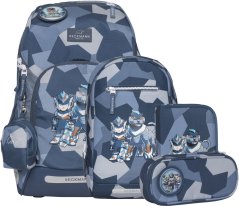
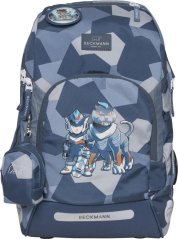
Set Active AIR FLX Tiger Race School set BECKMANN 2023
 In stock
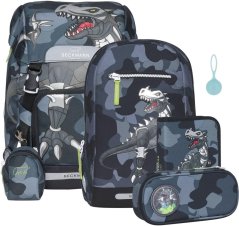
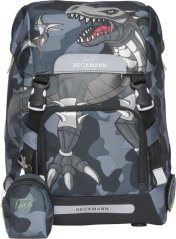
Set Classic Camo Rex School set BECKMANN 2023
In stock
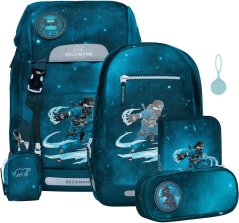
Set Classic Ninja Master School set BECKMANN 2023
In stock – last piece!
Classic Camo Rex School backpack BECKMANN 2024
In stock
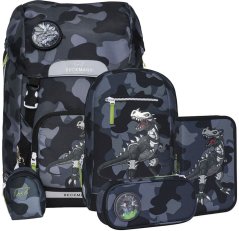
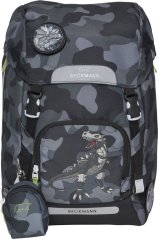
Set Classic Max Camo Rex School set BECKMANN
In stock


 Register